I’m proud to say that our Designhounds programs are celebrating their 15th anniversary this year. Fifteen years! Dozens of designer tours, retreats, conferences, and collaborations — all fueled by your creativity, your curiosity, and your willingness to follow us into whatever wild new idea we cooked up next. Thank you to all of you who have let us dream, build, and push this industry forward.
But now I need to challenge you, because the world we design for is changing faster than our industry is. And if we want to keep thriving, we need to see what’s coming before it steamrolls us.
So indulge me for a few minutes. Let’s talk about the future.
A Marketplace That’s About to Flip Everything We Know
We’re standing at the edge of the biggest lifestyle shift in generations — arguably ever — and it’s happening quietly right under everyone’s noses.
Here’s the short version:
By 2030, over 75 million Americans will be 65 or older.
And unlike generations before them, this group has very specific ideas about how they want to live. (See my “Aging Badasses” thoughts here — it’s not your grandmother’s golden years.)
The Caregiver Support Ratio is changing fast.
Nationally, the number of middle-aged adults available to care for one very old adult was roughly 5:1 around 2020 and is projected to fall to about 2:1 by 2050. In other words: fewer potential caregivers, more older adults, and a caregiving system under real strain.
And even though the number of unpaid family caregivers is growing (from 43.5 million in 2015 to 53 million in 2020), that increase isn’t because life got easier — it’s because need is outpacing capacity PLUS we’re staring at a projected shortfall of 4.6 million paid home-care workers by 2032.
So yes, people will still be cared for — but our current model is nowhere near sustainable. Homes themselves will need to shoulder more of the work.
The largest wealth transfer in U.S. history is coming BUT….
Boomers will transfer between $50-80 Trillion to Millennials by 2045…. (Gen X is, once again, not invited to the party. We remain the ugly stepchild of the economy, insert sigh.)
….but here’s the twist: If Millennials are hit with soaring living costs and unexpected caregiving roles, that wealth is going to evaporate much faster than anyone planned.
This Isn’t Doom. This Is Opportunity — IF We Wake Up.
I’m not saying the above is bad.
On the contrary — there is enormous opportunity here if our industry isn’t asleep at the wheel.
This moment demands new thinking. New design priorities. New business models.
Design must evolve. And designers must lead that evolution.
Living Well Isn’t a Luxury. It’s a Lifeline.
Our homes can no longer be pretty backdrops. They must be engines for wellbeing — physical, emotional, financial, and deeply human.
Homes must:
support wellness in all age groups
reduce stress
prevent injury
provide safety
adapt to changing mobility
keep us independent longer
protect our identities, cultures, and lifestyles
all while evolving with us for decades
Not “luxury.” Not “nice to have.”
Necessary.
Responsive Homes Need Responsive Design
The homes of the future must be responsive ecosystems, capable of much, including:
adjusting lighting for circadian health
monitoring air quality
using materials that don’t harm us
integrating technology that protects without overwhelming
anticipating needs instead of reacting to crises
And these homes need to grow with us:
when we’re raising children
when we’re building wellness habits
when the kids leave and we want to monetize part of the house
and finally, when we want to age safely — with dignity, identity, and style
This is not 2050. This is now. Clients will be asking for this in 18 months. Some are asking already.
And the designers who understand it will be decades ahead of the market.
Introducing:
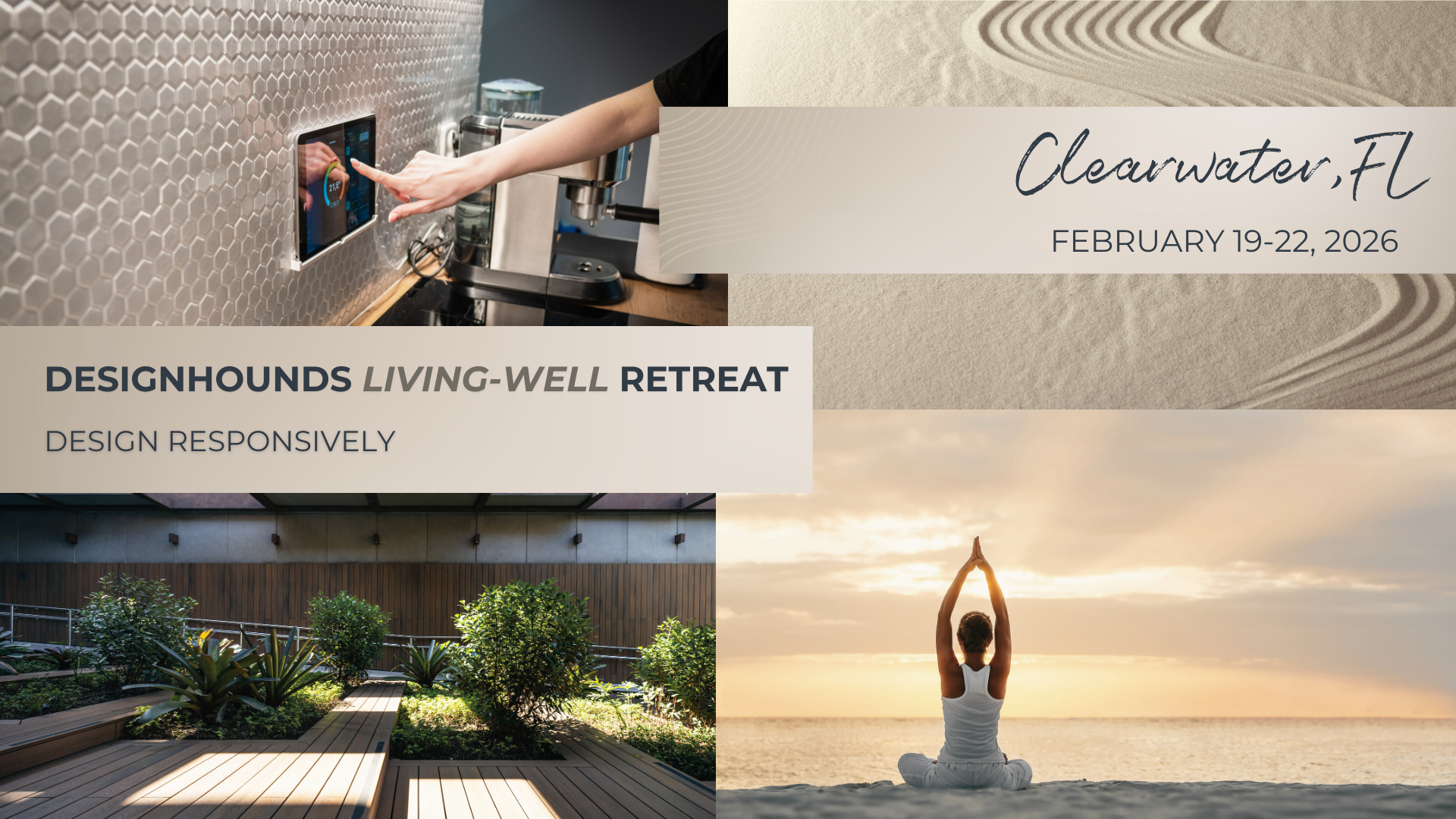
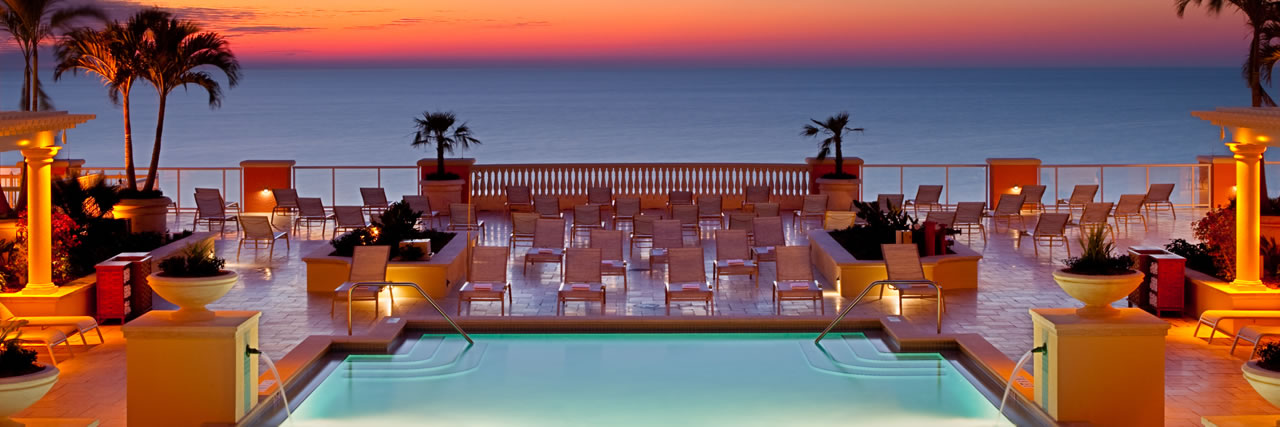
The Designhounds Living-Well Retreat – Clearwater, Florida
Feb 19–22, 2026
This is not a just a beach break or a wellness weekend.
This is a design briefing on the future of home.
At the Designhounds Living-Well Retreat, we will challenge you to:
explore tools to prioritize wellness – for yourself, your clients, your projects
imagine residential environments for the next three decades
rethink home design from the inside out
design not for “how we live today” but for how YOU want to live tomorrow
understand aging, autonomy, integrated tech, and wellness as design mandates
explore the emotional and psychological dimensions of living well
We’re going deep — design psychology, longevity planning, healthy materials, lighting science, integrated technologies, and the real economics of aging.
We’re here to redefine wellness in design and rethink the future of living.
If you’re ready to be part of the next evolution of residential design — and to help lead it — then you belong in Clearwater.
February 19:Opening Night: The New Definition of Living Well
6PM-9PM:
Welcome reception & keynote: “The Home That Heals: Why Designers Now Influence Lifespan.”
Evening reflection activity: Design Autobiographies — How do YOU want to live at 70, 80, 90?
February 20 – The Empowered Design Pro
9AM – 12:30PM:
Warm up mediation and movement
Workshop: Can’t Pour From An Empty Cup: Designer Wellness As a First Priority led by Megan Mazzocco
Presentation: Dare to be Excellent – To Yourself: Empowered Design Pros Live Longer, Work Happier and Make More Money led by LuAnn Nigara
Roundtables: Share Design Autobiographies – How do YOU want to live at 60,70, 80 and beyond
12:30-1:30PM Group Lunch
Afternoon optional tours to St Pete’s museums (think Dali and Chihuly) and design/antiques district
Sunset wellness program (movement and sound bath workshops)
February 21 – Design Responsively –How Design Moves from Luxury To Necessity
9AM – 12:30PM:
The wellness business: How authentic focus on wellbeing and fitness offers makes great design as necessity led by Jana Donohue
Integrated Technology Lab: circadian lighting, sensor-based safety, AI-powered planning, smart kitchen/bath for aging support led by Katye McGregor Bennett
The Home as Financial Support System: Homes that Earn ADUs, rentable annexes, flexible wings, and multi-generational planning led by Jessica Duce
Think Tanks: Which products/features do you want to see in every home of the future
I wish manufacturers would make a …… that did …….
I wish we could all live in ……. that ……..
Had I known that I would …… I would have ………
12:30-1:30PM Group Lunch
Afternoon: Reserved beach/poolside seating for deep dive discussion or just enjoying your feet in the sand
7PM Farewell group dinner
February 22: Your Design for the Future: A Closing Challenge
8AM – 9AM:
Final take home assignment: “Design Your 2055 Home”
Closing keynote: “If design doesn’t lead, who will?”